
We are in a whole new world of publishing—there has been a fundamental shift in how the business works and how authors make money.
In the past, the only way you could be successful as an author was if you were lucky, rich, or connected. Most times, you needed to be all three.
Now, an author has much more control over the direction of their career. Those who get good at the business of publishing will do much better than their peers, past and present.
The traditional publishing world is resisting this change, which is understandable. Many authors are also resistant; still willing to accept the constraints and conditions of a broken business model.
With authors, I believe this resistance is not from an attachment to the old world, but from a set of fundamental misconceptions about what independent publishing is. Many also lack confidence in their ability to take advantage of the new publishing model and build a successful career.
It doesn’t take a lot of research to see that there are many myths holding writers back from building a successful career. Out of the multitude of lies and half-truths about writing, I believe four core myths act as artificial barriers to authors being successful.
The four myths are:
- The Starving Artist
- Indie Books Don’t Sell
- You Must be Traditionally Published to be a “Real Author”
- Traditional Publishers Can Do Things You Can’t
I often joke I am the Jerry Maguire of nerds. Whenever I hear someone claim the truth of something, I am always saying, “Show me the data!”.
It doesn’t take much additional research to find data that exposes these myths as the pile of nonsense they are.
Building a successful writing career is hard enough, without setting up obstacles in your mind that aren’t based on the slightest shred of truth. In this chapter, I will show you research and data that debunks all these myths. I will start with the nastiest of them all—the starving artist myth.
Myth 1: The Starving Artist
If everyone applied their writing craft to this myth, the starving artist meme wouldn’t exist. Not only is it both a cliché and a stereotype, but authors need to stamp out its existence with the same diligence as eradicating adverbs and passive voice from their prose.
The starving artist myth leads to a lot of assumptions, the most harmful assumption being that a career as a well-paid author is beyond the reach of all but a lucky few.
The simple fact is there is, and always has been, great gobs of money to be made in books.
In 2022, global book sales were around USD79.5 billion and are projected to grow to around USD83 billion this year (2023). It’s obvious someone is making money somewhere!
The reason authors have always fed on the scraps of the book publishing gravy train is not that book publishers are a bunch of thieves, but because of the structure of the industry.
Traditional publishing works like this:
- The bookstore makes a profit selling to the reader
- The distributor makes a profit selling to the bookstore
- The publisher makes a profit selling to the distributor
- The publisher deducts production costs and gives the author 8–15% of what’s left.
To illustrate my point, let’s try a more concrete example. Let’s say you write a mass-market paperback that retails for $14.99.
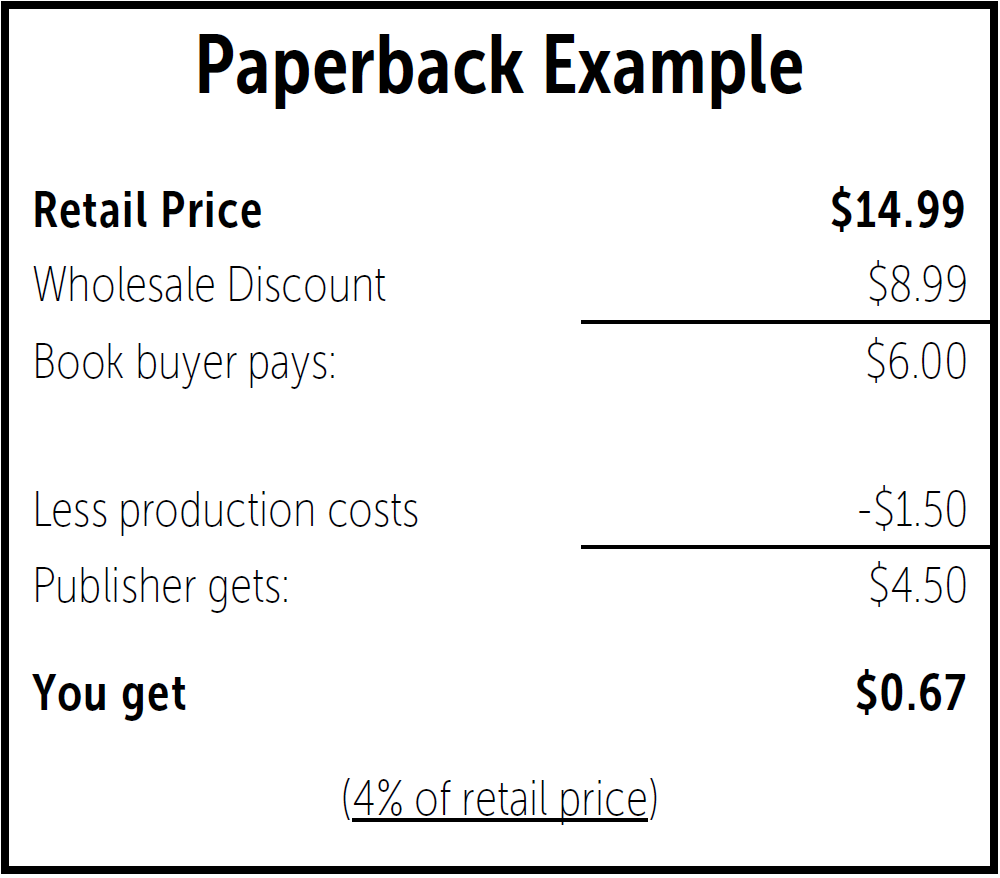
The book buyer buys the book at the standard wholesale discount (60%)—so they pay $6 for the paperback.
Assuming production costs are $1.50, your publisher gets $4.50.
You get a 15% commission on the $4.50, which adds up to a paltry 67 and a half cents royalty on a book that sells for $14.99—which is about 4% of the retail price.
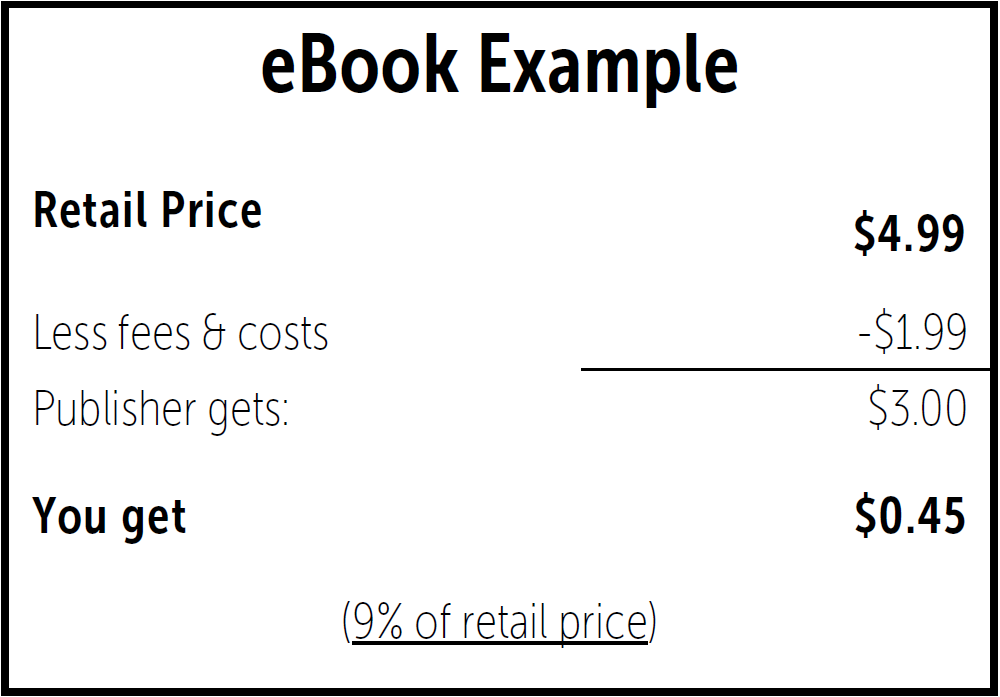
Your return on an eBook is not much better. If you publish an eBook that retails for $4.99, your publisher will get on average about 60% of the retail price as there are no production costs. Your publisher pays you the same 15% royalty, and you get 45 cents—which is about 9% of retail.
Remember, these are examples to illustrate how the structure of the industry works against you. Looking at royalties from my own traditionally published books, and data from other authors, the numbers err on the side of being generous.
Let’s use these numbers to see how they might affect an actual author.
If you want to see the starving artist myth in all its glory, you don’t need to look past author advocacy organizations. They have all been crying poor for just about forever. Without singling them out, I will use some recent data from The Authors’ Guild (USA). According to their 2018 members’ survey, the median income for all authors was about $6000 a year. We can use this earnings estimate to turn the previous examples into potential sales numbers.
For the sales numbers, I will assume that the author’s sales are 70% eBooks and 30% paperbacks (total sales, not total dollars). This is close to the global average on Amazon.
To make $8000, the author needs to make about 10,000 unit sales in a year.
For starters, 10,000 unit sales is great—way more than the oft-quoted, but unverified myth that the average book only sells 500 copies in its lifetime.
The kicker here: guess how much his publisher would make on these sales?
$34,000
Now before you all reach for the pitchforks and knives, am I saying our dear old traditional publisher is pocketing all this money? No.
While some of that money goes towards those plush offices in London, New York, and Paris, most of that money disappears into the massive cost of running a traditional publishing business.
This is relevant to the starving artist myth because it’s hard to avoid the constant messages of doom and gloom from the publishing industry.
You need to see this for what it is—book publishing is not dying. Traditional publishers are the ones dying, or at least shrinking at a rapid rate. This contraction of their business model is visible in the many closures and mergers among traditional publishers.
It’s not book publishing that’s failing, but the traditional publishing business model.
For over 100 years, the way to get a product to the consumer was the same:
- The manufacturer supplied goods to the distributor;
- Who supplied goods to the retailers;
- Who sold the goods to consumers like you and me.
When the Internet came along, it enabled manufacturers and distributors to sell directly to the consumer. The Internet had a huge effect on global distribution and retail businesses. These changes are not unique to traditional publishing—the same structural changes occurred in many industries like fashion retail, communications, photography, and electronics.
The new business model looks like this:
- You make your books available on Amazon;
- Amazon makes a profit selling to the reader; and
- You keep the rest.
Amazon is not the only bookseller online, but it is the biggest. The same process applies to all online booksellers.
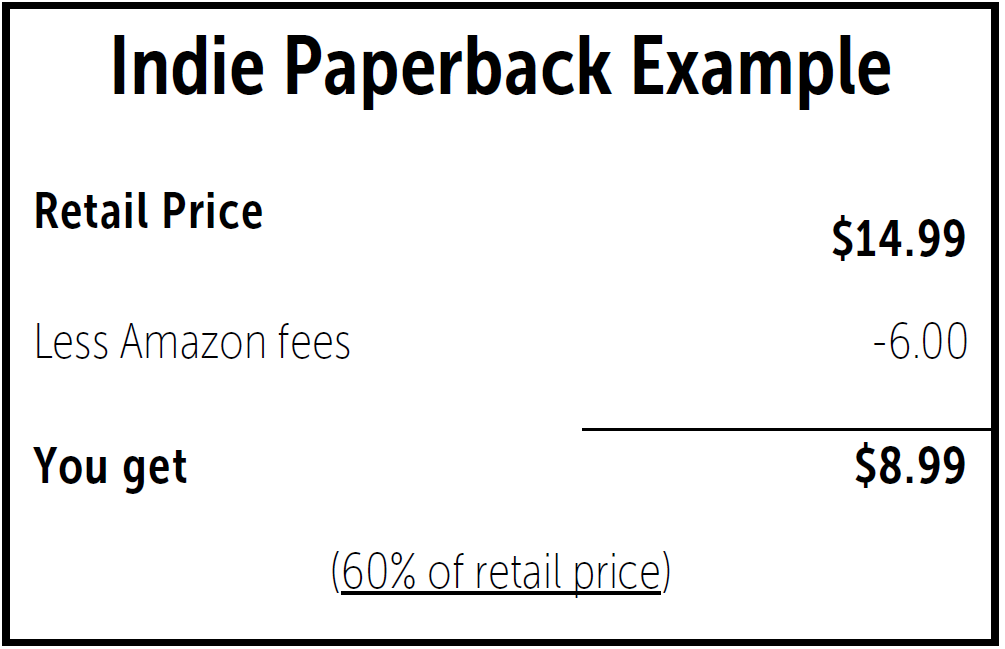
Let’s see how this new model affects what an author earns. Using the previous examples, for most indie authors, “the rest” is about 60% for paperbacks:
… and 70% for eBooks:
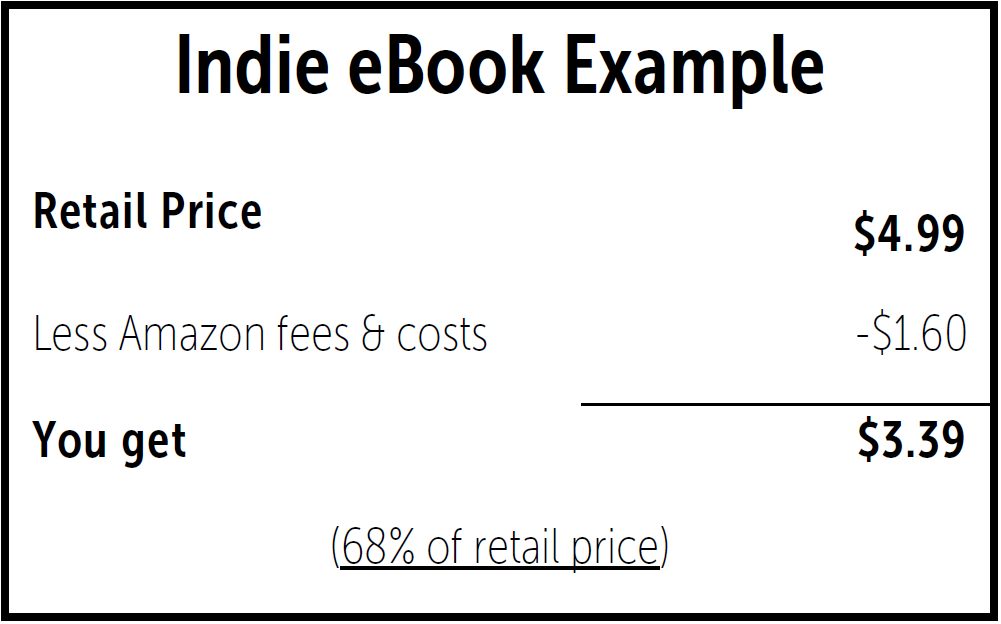
The critical take-home from these numbers is that the indie author is making between 7 and 13 times as much money on each sale as his traditionally published peers.
This, folks, is why indies not only hold the keys to the kingdom, but they’ve run away with the crown jewels too!
So, on 12,000 unit sales, what does this difference add up to for the author?
$60,000
Whoa! Not only is our author far from starving, but they’re making more money than the author and the publisher combined in the traditional model.
These are only rough calculations to illustrate my point, but what about hard data?
A similar survey to the Authors Guild, commissioned by the Alliance of Independent Authors (ALLi) showed the median income for self-published authors in 2022 to be $12,700—more than double the income of The Authors Guild respondents.
This was median income, which helps reduce the skew created by the top 10% and by large outliers. If you take everyone into account, the average income of indie authors in 2022 was just under $83,000, with 70% of authors earning over $20,000, including 28% earning more than the magic 6-figures.
So, you can see my rough calculations are actually borne out by the data—indie authors are pocketing a sizable chunk of that $34,000 eaten up by the traditional publishing machine and have built a solid, full-time income for themselves.
Myth 2: Indie Books Don’t Sell
Did you ever hear the story that the average book sells only 500 copies in its lifetime?
Or the one where the average self-published author sells 500 copies and the average traditionally published author sells 5000?
I bet that if you haven’t heard the above, you’ve heard several variations.
So, have you ever stopped to wonder where these numbers come from?
It turns out they come from traditional publishers. For many years, traditional publishers relied on retail book sales statistics that were both out of date and didn’t cover the entire book market.
How much do you think we can trust these numbers?
Not at all would be the correct answer.
It’s the same answer Hugh Howie came up with a few years back. If you don’t know Hugh, he’s the guy who wrote Wool and is one of the early Kindle pioneers. He made the first part of his fortune as an indie and megabucks selling Wool and subsequent books to traditional publishers and streaming services.
It frustrated Hugh that these miserable statistics were the opposite of his own experience and the experience of authors he knew. So, with the help of a data guy named Paul Abbassi, he created Author Earnings—a site dedicated to collecting timely sales data on all books sold on the Internet. Over several years, Author Earnings grew until it could track millions of book sales in real time.
Unfortunately, Author Earnings shut down in early 2019 so Paul could commercialize the tracking technology. This was an immense disappointment to the thousands of indies who supported him; however, by then it was too late. The live data was out, and that live data painted a much different picture of the market.
So, let’s look at what the data said.
Of the US$4.5bn in book sales in the US in 2017, Indies made up 42.6% of total online unit sales or just over 113 million units. The Big 5 were just under 26% of total unit sales. Which kills the myth dead right there—indies were selling far more units than traditionally published authors, even back in 2017. Close to twice as many, in fact.
If you take out mega-sellers like Nora Roberts and J. K. Rowling, the numbers are even more skewed in the indies’ favor. But what about revenue?
In terms of total dollars, indies earned about US$314 million. The Big 5 were still ahead of the indies in 2017 with US$559 million in overall earnings, but remember—this is total dollars earned, not author income.
Fast forward five years to 2023 and over 300 million self-published books are sold each year—nearly three times the unit sales in 2017. These sales generated $1.25 billion in revenue, four times what self-published authors earned in 2017.
It’s arguable that much of this increase is because of the massive increase in the number of books being published in the last five years because it’s so easy to self-publish. This is true to a degree, but it misses an important detail.
First, the actual increase in the number of self-published books is 264%, which could account for the increase in unit sales but not for the jump in revenue.
Going back to the ALLi survey, it showed the median income for self-published authors in 2022 was $12,700, but the average income of indie authors in 2022 was just under $83,000.
This is because the authors at the top of the income scale are pulling most of the income, which increases the average income.
Indeed, you can see this trend in ALLi’s figures because 70% of all respondents earned over $20,000, which is higher than the median. The 28% of respondents earning more than the magic 6-figures pulls the average higher again.
These numbers do highlight that most of the revenue goes to the top authors, but that has always been the case. At least with self-publishing, you only have to be in the top 30% of authors to make a comfortable living. For traditional publishing, it’s closer to 0.3%. Assuming you can get a book deal in the first place.
Bottom line: not only do indies that put out quality work and work to position themselves in the top 30% sell more units, but they make more money too.
To quote a favorite show of mine, this myth is busted.
Myth 3: Traditional = Real Author
I believe that this is the most insidious myth of all—the assumption that to be a “real” author, you must be traditionally published.
There are two versions of the “traditional is better” myth:
- Indies don’t win literary awards, so traditionally published books must be “better”
- Anyone can self-publish, but it’s tough to get traditionally published, so by definition traditionally published books must be “better”
Version 1 of the myth infects far too many authors, even some of the best. Stephen King has lamented the lack of literary awards in his career, so did Australian author Bryce Courtenay.
It’s ludicrous that any writer, famous or otherwise, could value the opinion of a committee over and above the millions (in King’s case, hundreds of millions) of happy readers who have devoured their work over the decades.
As an author who wants to make a career out of your writing, you are an entertainer. Or, with non-fiction, an educator. The measure of your success will always be the number of readers you entertain or educate.
Now, before this ends up sounding like a rant, I understand that as writers, seeking validation is normal. It’s why we are forever creating new stories to submit to competitions when we should be working on our magnum opus. It’s also why we recruit beta readers and reluctant friends and family members to read our work.
So, I get why winning literary awards will always be attractive to writers. However, setting them as the goal of your writing career, rather than a nice bonus for putting out good work, is plain silly.
Version 2 of the myth is more dangerous to your career, as it contains a kernel of truth. So, ignoring that traditional publishers also put out a lot of crap: yes, anyone can self-publish. There are no barriers to Uncle Mike publishing his 600-page memoir about drying paint—but this misses the point.
The mountain of dross published each year is no more relevant to your career than the dust bunnies at the back of your bed; they will remain unnoticed until someone cleans them out. The only ones who ever even mention this crap mountain are traditional publishers and misinformed authors who use it as a prop to bash the self-publishing industry.
This myth is why I distinguish between self-publishing and independent publishing. Any fool who thinks they can write can self-publish. However, it takes quality work, a keen eye for detail and strong business acumen to be successful at it.
The belief that the difficulty in getting traditionally published acts as a de facto quality filter is also flawed.
Any editor or agent will tell you that a huge amount of quality work will never make it through the slush pile. Even when a book makes it through the pile, the first question on the publisher’s mind is not, “Is this a brilliant book?”, it’s “Can I sell this?”. Publishing constraints also mean that a publisher can still drop a good book because they can’t fit it into the schedule.
To cap it off, if your book makes it through, there’s a good chance the publisher will pass the book to a freelance editor no more skilled than one you can hire yourself.
Real authors are authors who work hard to improve their craft, put out quality work consistently, and look after their readers. In the modern publishing world, if you nail these three things, you will succeed, regardless of whether you go with a traditional publisher or self-publish your books.
Myth 4: Traditional Publishers Can Do Things You Can’t
There was a time, way back in the Dark Ages, when it was hard to get a book to readers. First, you had to get an agent or a publisher interested in your work. Collecting hundreds of rejection slips was the norm.
Even if you bypassed the system and published your work, you paid thousands of dollars to print a minimum number of copies. Then there was no-one to buy them. Bookstores would rarely stock self-published books, and selling them out of the trunk of your car or at book conventions was hard work.
A very lucky few got through the system and made a success of their writing. Most authors gave up.
Because the publishing world was like this for so long, the myth that traditional publishers can do things you can’t still holds writers back today.
Let’s break this myth down. The most often cited benefits of a traditional publisher are:
- Traditional publishing has more credibility
- You will get an advance
- A traditional publisher will market for you
- You will get quality editing, covers, etc.; and
- A traditional publisher will get you into bookstores
The first cited benefit is by far the easiest to debunk with a simple question:
“When was the last time you bought a book because you liked the publisher?”
Who published your book is irrelevant to readers. The only person likely to be pretentious about who published your book is a traditionally published author who just learned how much more money than them you earn.
What about advances? While authors often complain about the size of their advances (and how they have diminished over time), nobody has ever complained about getting one. It’s a shame because if authors, especially new authors, took a moment to question the status quo, they would see how bad a deal advances can be.
First, there is almost zero chance that a new author will get a large advance. There is no hard data available because nobody publishes details, but $5000 is about the maximum from my research.
New authors are susceptible to advances because they must decide between instant and delayed gratification. New authors often have a nagging question in their mind: do I take the money now, or do I wait for a better deal?
Assuming your luck holds and you get a publishing contract, after you receive your advance, you won’t see any money in your account for at least a year.
It will take the publisher at least six months to get your book to market. It will then take at least another six months for you to get royalties because many pay quarterly, three months in arrears. For example, you will get paid at the end of December for royalties earned in the three months to September. For publishers that pay half-yearly and annually, you will wait even longer.
You will also get nothing in your pocket until you earn out the advance. Before you get your hopes up about that happening, publishers expect that around 75% of the books they publish will never earn out their advance. So in most cases, the “at least a year” I mentioned a moment ago translates to “never”. Depressing stuff!
Using our previous examples, and assuming an advance of $2000, you would only need to sell just over 500 eBooks in that year to equal the advance. The money would also go straight into your pocket the whole time.
There is also the question of rights. A publisher will take as many rights off your hands as they can in the publishing contract. This includes eBook, print, audio, and translations. And you won’t get any of those rights back until the book goes out of print, which, given the wording of most publishing contracts, is close to never.
This point is relevant because it’s possible the advance is the last dollar you will ever see for the book. There is also no way you can rectify the situation without negotiating a return of the publishing rights to you.
When you self-publish, the rights are yours. Forever.
We can examine the final three benefits—marketing, quality, and coverage—with a simple example. For a new author, a traditional publisher will:
- Give the book to a professional editor
- Commission a cover
- Pass the edited work on to a typesetter/digital layout expert
- List the book on Amazon (and others)
- Add the book to distributor catalogs; and
- Leave all marketing up to the author
If you self-publish your book, you will:
- Give the book to a professional editor
- Commission a cover
- Pass the edited work on to a typesetter/digital layout expert
- List the book on Amazon (and others)
- Add the book to distributor catalogs (by checking a box on KDP); and
- Market your book
Recall our earnings examples from earlier in the chapter? In terms of income, your traditionally published book would need to sell between 7 and 13 times as many copies as your indie-published book to equal your indie earnings.
Hmm. You’re doing the same work but have ten times the expectations?
Sorry, but that sounds crazy to me!
There is an obvious “but wait!” here. Can you spot it? Yes, when you publish your work, you will pay for items 1 to 3.
Let’s assume you paid $3000 for these services (that’s towards the high end). With the vast difference in profit, you would only need to sell 800 eBooks to make all the money back.
The only thing of value that traditional publishers controlled in the past was access to the market. You have always been able to hire editors and cover designers and printers, but without access to the market, you had a high chance of failure.
Now, you can sign up for KDP and make your book available to millions of readers in half an hour. If you publish a quality book that looks professional, the odds tip in your favor. As you saw earlier in the chapter, the data confirms this. Indies are not only selling more units (at least in digital), they’re making more money than their traditionally published cousins.
That’s it for the four big myths. Before we go on to the next chapter, I want to cover one more thing. Lest someone accuses me of bashing the traditional publishing industry, it does still have a place in modern publishing.
Traditional Still Has its Place
While the point of this book is to make a strong case for indie publishing, that doesn’t mean there isn’t a place for traditional publishing in the modern market. My first book is traditionally published; my second sold to a traditional publisher after I self-published it. I sold that book on my terms, though—I kept my digital rights and exclusivity on Amazon. I also got paid 50% of net, not 15%.
There’s still a place for agents, too. They can provide access to markets that require submissions through an agent. They can also provide access to foreign markets where local knowledge is an advantage. For example, I have a recent book with a Korean agent who is shopping around for a buyer for Korean translation rights.
Traditional publishing is still a good path to take when you want to take your great-seller and turn it into a mega-seller.
At the top end of town, traditionally published authors still dominate. Examples include long-tenured, mega-sellers like James Patterson, Nora Roberts, George R. R. Martin, and J. K. Rowling. Once you get down to the top 1000 authors, however, more than a quarter of them are indies.
In recent years, the indies have increased their share of this market, and current data shows the rise of Amazon imprints; all of which give the author a better deal than the Big 5.
There is also the 50% of print book sales that aren’t online. This is the bookstore market, although these days bookstore is a misnomer—most of these print books sell in department stores and from end caps in airports. Traditional publishing still has a majority stake in this market, although indie-friendly distributors like Ingram Spark and KDP are gaining an increasing share of this space.
Remember though, unless you win the publishing lottery, for your book to be attractive to a traditional publisher, you need to have done most of the work already. Proven success as an indie will also factor in their decision to publish your work. At that point, you must ask yourself whether you still wouldn’t be better off on your own.
That’s it for the self-publishing myths. I hope I banished any of your misconceptions about self-publishing and opened your mind to the opportunity that awaits you as an indie publisher.
In the rest of Part 1, I’ll teach you the practical skills you need to be a successful indie publisher. We’ll start with the five mindsets you need to adopt to go from author wannabe to professional self-publisher.