
In this chapter, we will tackle the biggest perceived barrier to publishing success—marketing your books. In the surveys I have conducted, and in the research I have done, book marketing is a common pain point. Writers are often confused about what effective marketing for authors is. Many who have tried to market their books are frustrated with poor returns, despite spending more time marketing than writing.
Of all the poor advice a budding writer can find online, book marketing advice is by far the worst. A simple search reveals many examples of so-called “marketing secrets” regurgitated ad nauseam. It’s made worse by the fact that many of them contradict each other.
This cancer doesn’t just infect book marketing; poor marketing advice is rife in many markets. It has a greater impact on writers, however, because if you are wasting time following this advice, you’re not writing. And as I have written before, the immutable math of book publishing is that to increase your success, you must write more and sell more.
I am sure that with all this terrible advice going around, many of you are approaching this chapter with some trepidation. You needn’t worry, though. While some of the following might be difficult to accept because it’s contrary to what you have heard, my approach to book marketing is dead easy to implement.
As you will see, in book marketing, less is more.
Don’t believe me?
Well, here are some of my own stats. To date:
- I have two social media accounts—Facebook and LinkedIn. I have never created an account on any of the other platforms.
- I do nothing with my LinkedIn account except update my profile once in a blue moon.
- I infrequently post on Facebook.
- I have never paid a cent for advertising.
I first wrote these points out in 2019. In 2026 I’m down to just LinkedIn.
I was never into Twitter and now it’s X and a cesspool of hate owned by an arsehole, It’s on my blacklist. The other social media biggies – Instagram, FaceBook and TikTok – are a mess of more hate, ads and AI garbage, so I’ve decided to call time on them too.
I don’t have anything against social media per-se. I live in hope that someone comes up with an app model where humans can enjoy the genuine human connections fostered by such an app and not be the victims of algorithms designed to enrich the few at the expense of the many.
Today’s big-name authors were around before social media existed. J. K. Rowling wrote the whole Harry Potter series before having a Facebook account, and even the darling of the indies, Hugh Howey, was well on his way when Facebook had less than 100 million users and MySpace was still a thing.
I am not singling social media out here, but this is where 99% of online advice on marketing for authors is directed. As I will show you in this chapter, social media can be useful, but it’s no panacea.
Before we move on, I am not saying all book marketing advice is terrible, but a sensible businessperson questions its source. Always remember that most online marketing gurus make their money selling you their “secret formula”, not from using the formula. This is the good old-fashioned selling the sizzle tactic used by the multi-level marketing industry for decades.
EXERCISE—Conduct a Marketing Reset
NOTE: This exercise is for authors who have been marketing their books. If you don’t have a book ready or have not marketed your books yet, you can skip to the next section.
I want you to stop for a few minutes and complete an exercise for me. Don’t skip this because I bet once you have completed the exercise, you’ll feel a million bucks.
We’re going to conduct a marketing reset.
Chances are, you have tried several things to spread the word about your books and increase sales. Chances are also that most of them didn’t work, or you aren’t sure if they worked.
This exercise eliminates everything that doesn’t work for you, so you can concentrate on the things that do.
Step 1
Write out everything you have done in the last 12 months to promote your books and increase sales. It doesn’t matter in what order, we’ll get to that next.
Step 2
Cross out everything on the list that didn’t result in an increase in sales. It doesn’t matter if you’re not sure at the moment—go with your gut feeling about what worked and what didn’t.
With some of these activities, you will question yourself; you will wonder whether something you did caused them to fail. Don’t do this—go with your experience, not with what some guru says should or shouldn’t have worked. If you don’t think it worked for you, cross it off.
Step 3
Look at the items you haven’t crossed out yet. Your list should include only items you are confident increased sales.
For each remaining item, ask yourself, “Was it worth the effort?”
This is an important step, so take your time.
Consider the time and money you spent on the activity. Looking at the results, would you do it again?
In Part 2 of the book, I will show you how to calculate the return from a marketing activity. For now, let’s leave the math and go with your gut feeling again—anything you don’t think was worth the effort, cross it off the list.
Step 4
Reorder the remaining activities so that the most beneficial is at the top of the list, and the least beneficial is at the bottom of the list. You can go with your gut feeling again if you’re not sure. Don’t worry if this is all guesswork at the moment. I will show you in a later chapter how to collect accurate data.
If you crossed everything out, that’s OK.
Step 5
Stop doing everything you crossed out. Right now.
Never do them again unless you learn something new and want to try them again.
How do you feel?
Like a huge load has lifted?
Like you might find time to write now?
I hope so. I know when I sat down and worked out what was working and what wasn’t, my business changed forever. I was doing less work and making more money.
Over the years, I’ve been so busy at the day job, I’ve done nothing at all. I have not posted a single social post or updated my site or sent an email, and my monthly income didn’t drop in any noticeable way.
So, now that you have completed the exercise, you should have a short list of things you know will help your writing career. Your list may be empty, but that’s OK too, because I am about to show you what works.
The Secret to Successful Marketing for Authors
Book marketing is the most misunderstood part of the independent publishing process. It’s the most common reason authors don’t self-publish or have been unsuccessful at self-publishing. How many times have you heard (or said yourself!):
- “I hate selling”
- “It’s too complicated”
- “I will never get the time to write”
- “I posted until my fingers bled and only 3 people liked me”
These statements are common because it’s easy in our modern, information-overloaded society to lose the signal in the noise. And it is noise, especially for authors, because the underlying signal, the one fundamental tone that makes it all work, is so simple most authors kick themselves for not realizing it sooner.
There is only one proven marketing tool for authors, and it’s one you already possess.
It’s your writing.
This doesn’t mean you publish your book and hope for the best—this is “build it, and they will come” thinking, and we know that doesn’t work. To go from zero to an independent author making a good living, you must first overcome one barrier. This barrier isn’t money or your lack of industry contacts; it’s not geography, and it’s not your lack of 3 million fans on Facebook.
It’s trust.
When you think about it, it’s obvious—what do we value above all things online? It’s trust. We go to the sites we trust the most; we only buy things from sites that have the padlock and trust logos. We are wary when a stranger contacts us. It’s the reason we ask our friends for recommendations, read reviews, check out a book’s star ratings, and read the sample chapters.
When a potential new reader comes across your work, trust is the only barrier, and the trust question is simple:
“Will I enjoy reading what this author has to say?”
If the answer is a confident yes, they will buy your book. Simple as that. This is the same for fiction or non-fiction, except with non-fiction the reader is more likely looking to learn something rather than for entertainment.
And when they’ve finished your book, if they like it, they are not only more likely to read your other books, but they will also recommend it to their friends.
This is why your writing is the single most powerful tool in your author marketing toolkit, because giving a potential reader the opportunity to read your work allows them to make a definite decision about whether they like your work enough to buy your books.
It also explains why blogging, and all forms of social media, are lousy places to sell books. There is no way any of these forums can provide as definitive an answer to the trust question as reading your work.
Which brings us to the chicken and egg question: “How will they know if they like my work enough to buy it when they need to buy it to see if they like my work?”
The answer is simple:
You have to give it away. For free.
And not the meh stuff, your best stuff.
This is counterintuitive, ridiculous even, and terrifying. Most authors resist giving their work away, but it is critical to your having any long-term success.
Internet marketers rarely agree on anything, and each guru is convinced they hold the recipe to the secret sauce, but do you know the one thing they all agree on?
Growth only happens when you create content that users want to share.
And free stuff is infinitely shareable, as it provides potential readers a zero-risk way of sampling your work. Unlike cat videos and celebrity memes, readers place a high value on your sharing your creative talent, and they will reward you with their trust and loyalty.
This fundamental principle underpins all discussions of platform, ninja marketing, 6-figure launches, and whatever else is the flavor of the month. When you understand this, most of the stress and confusion related to book marketing disappears.
Understanding that you must give stuff away to grow your career is key to your success. It’s what took me from picking up scraps at the fringes to making enough money to quit my corporate day job for a while. And it wasn’t a simple cheat sheet or two I gave away: I published a 650-page textbook that took me 14 months to write in its entirety on my website for free.
This principle is what honest educators in the indie space will teach you. When you research successful indies, you find that all of them are giving great content away. A perfect example of this principle in action is Andy Weir, author of The Martian. He published The Martian in parts on his website until his readers demanded he turn it into a book so they could buy it. And they did—in their thousands—and as you know, the rest is history.
There is a wrong way and a right way to do this, which I will show you in Part 2. The super-important takeaway from this chapter is that success as an author, indie or otherwise, has nothing to do with how many social media followers you have.
What matters is putting out high-quality content and gaining the trust of readers by providing them with a zero-risk way to sample your work.
Now that you understand the secret behind becoming a successful author, I will explain my simple and effective approach to marketing for authors.
Marketing for Authors
Once you realize the secret to book marketing is building trust with potential readers, you can see there is nothing sleazy or even difficult about book marketing.
You do not “sell” books, nor are you trying to make people buy your book. You are putting it out in the market and making it easier to find for those who are already looking for a book just like yours. In fact, if you are chasing sales, you’re doing it wrong.
Of course, the devil is always in the details. First, you must filter out the readers who will never be interested in your work, so you can concentrate on engaging those that will. This is easier said than done, given most of the published marketing advice is flat out wrong for authors or has a very poor return on time invested.
To better understand the process of successful book marketing, I will use a staple of all marketing textbooks—the marketing funnel. Many of you may have seen variations of this concept, but they all mean the same thing: we pass through six stages before we buy something. You can apply these stages to a book purchase:
- Awareness. The reader is aware that they can buy a book online.
- Interest. The reader would like to buy a book to read.
- Consideration. Do they want to read a thriller or a sci-fi?
- Intent. The reader decides they want to buy a thriller, so they go to Amazon.
- Evaluation. The reader browses the selection of thrillers on Amazon to find one that interests them.
- Purchase. The reader buys a book.
Because much of the book market is online, many of these steps now happen in the same place, so the book marketing funnel is much simpler.
At the top of the funnel, you have the Internet. This is where the browsers are. Amongst the browsers are some people who would be interested in your books, and many more people who aren’t interested in your genre, or books at all.
All social media sites are at this level, as well as general and book news sites. Blogs (your blog, fan blogs, and influencer blogs) belong here. So do serial publishing platforms like WattPad and critique blogs like critters.org and scribophile.
Review sites like Goodreads also sit at the wide end of the funnel.
None of these platforms create raving fans on its own, and none of them are a good place to sell books.
Next in the funnel is the online book market. Its focus is narrower than the Internet because it’s a book buyer’s market. At least you know these people buy books, and if they like your genre, they are also likely to buy your books. This is also the level most unsuccessful indie authors assume is the end of the funnel, because it’s a point of purchase. They think once a book or even several books are up on Amazon and other book sites, that the sales will magically come. When they don’t, the author assumes indie publishing is the problem.
To be successful, you can’t view the online book market as an endpoint. Each book you publish must also direct readers further down your book marketing funnel.
The narrowest and most important part of the book marketing funnel is your website.
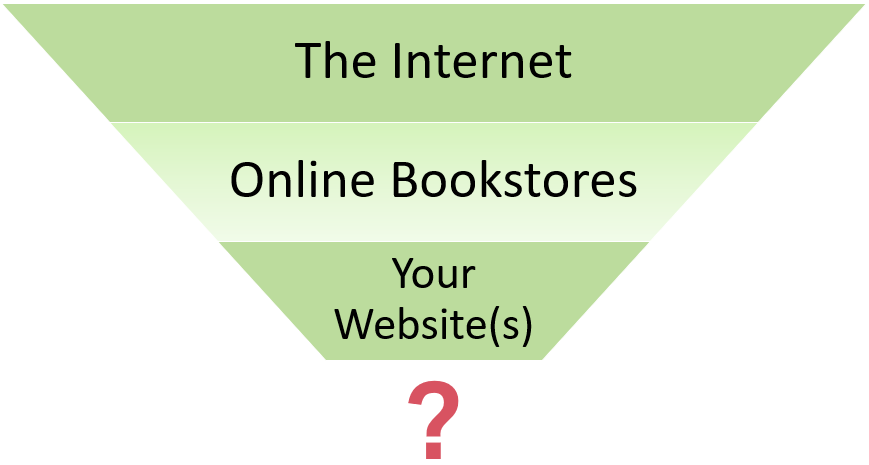
If someone is interested enough to look at your website, they have the potential to become something much more valuable than a person who just bought your book. Your website is your opportunity to turn book buyers into fans.
And I don’t mean this in the celebrity sense. I mean, the difference between someone who bought a book and a fan is the difference between one sale once and engaging someone who will buy everything you write for years and tell all of their friends.
It’s impossible to overstate the value of these readers. Statistics show that over 60% of all book sales come from some form of word-of-mouth.
Your website is also where you build trust with potential fans. This is where you put most of your free stuff. You can give out a free anthology or post short stories. Provide samples for download or give away a fan newsletter containing interesting news and updates; the list is endless.
Finally, at the bottom of our book marketing funnel, we have… a hole.
If a potential fan finds your site and is interested in your work, but they get distracted, or the Internet drops out, or they have no money this week, what is the chance of them ever coming back? What if someone buys your book on Amazon and likes it, but it’s another year before your next book comes out, what are the chances of them finding you again?
Even when they do everything else right, publish good quality books with good blurbs, and have a professional website, most authors forget to plug the hole. Tim Grahl, the author of Your First 1000 Copies, calls this the leaky bucket. Authors collect a bucket of readers over time, but they leak out of the bottom because the author put nothing in place to keep them.
So how do you plug the hole? With their email address. When you have a reader’s email address, you have a way of preventing them from leaking out. You can send them interesting stuff; you can let them know when your next book is coming out; you can send them updates on your current WIP; you can send them deals; and so on.
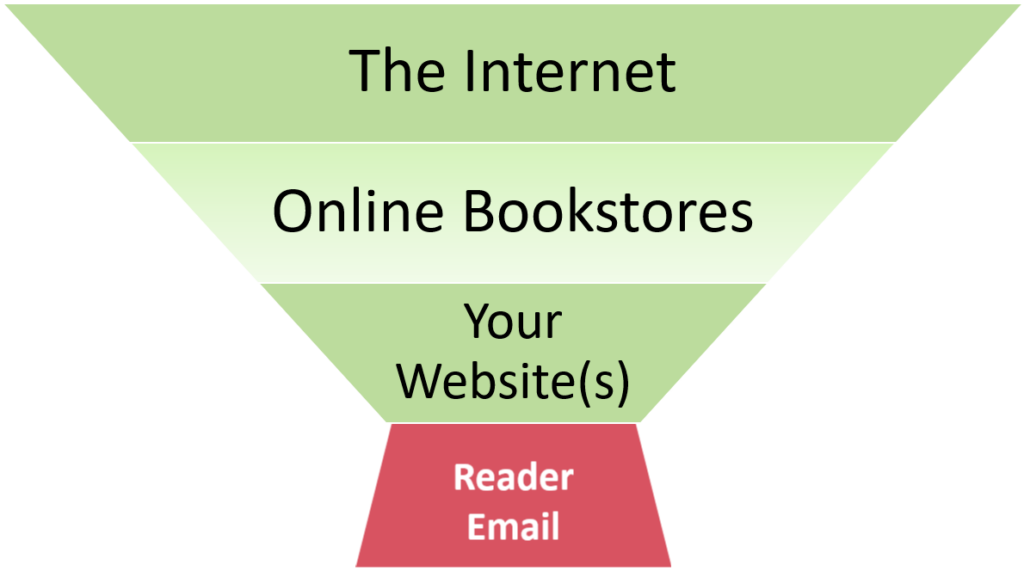
If you want to be successful as an author, not just an indie author, an email list is non-negotiable.
Remember what I said at the beginning of this chapter. Becoming a successful independent publisher is not about selling books; it’s about cultivating a fanbase for your work. The volume of sales you make will relate directly to the quality of your email list.
My Four-Step Book Marketing System
The book marketing funnel is not just an easy way to visualize how a potential reader passes through your marketing funnel on the way to becoming a fan. It also provides a handy framework for your book marketing process. This is the four-step marketing process I use with all my books:
- Reach out to readers who like the things you write about and direct them to your books and your website.
- Add a Call to Action (CTA) to every book you publish. The CTA directs the reader either to your other books or to your website, preferably both.
- Publish great content on your website that builds trust with your readers and turns them into fans. This does not mean blogging. While blogging can be successful for some, for most of us, it’s a waste of time. Great content means fresh stories and interesting bits from your books, including backstory and world building. For nonfiction authors, this is quality content that supports and promotes your expertise.
- At every step, look for opportunities to collect an email address so that you can keep in touch with existing and potential fans.
You will learn about each of these steps in much greater detail in Part 2. For now, the most important takeaway is for you to understand that book marketing doesn’t have to be complex to be successful.
Simple doesn’t mean easy, though. You must work hard at it, but as you will also learn in Part 2, you can automate much of it, freeing you to write.
The Value Funnel
The value funnel is a simple but powerful technique that helps you prioritize your marketing efforts. It ensures you spend more time on the things that are of the highest value.
But first, I am sure you are wondering how much time you should spend on marketing.
The correct answer is “less than the time you spend writing”.
Now you might think that’s not useful advice, but it depends on your circumstances and goals, so I keep it simple by saying:
The only hard and fast rule of marketing for authors is you should never spend more time marketing than writing.
Whether you only have a few hours spare a week to write or you write full time, the number one priority is to make sure you spend most of your available time writing.
If you want ballpark numbers, my view is that, unless you have a major launch in the works, never spend over two hours a week on marketing, regardless of whether you are a part-timer or write full time.
Yes, you heard right—two hours a week maximum. And that assumes you have at least 4 hours a week available for your writing—otherwise, do less (or even none).
I am sure you’re having a serious WTF?! moment right now. Especially if you’re unfortunate enough to have been sucked into the “post until your fingers bleed” cult, but I promise you, it’s true.
As I wrote earlier in the chapter, I’ve gone months doing nothing and not seen a drop in sales.
I am writing this early on a Thursday morning. The only marketing I did this week was I spent 40 minutes on Sunday night writing an email announcing a pre-sale of a book I am writing. So far this week, that one email has brought in $1200 in pre-sales from a small mailing list and for a book I haven’t written yet. I have repeated the same results for many book launches in the years since I first wrote the original paragraph back in 2019.
I am not doing anything you couldn’t do yourself. All I did was work out that with book marketing, some marketing efforts are much more valuable than others.
And this is where the value funnel comes in, which I like to think of as an inversion of the book marketing funnel. All the broad stuff (social media, etc.) are the lowest value. The value increases until your mailing list, which is your most valuable marketing asset.
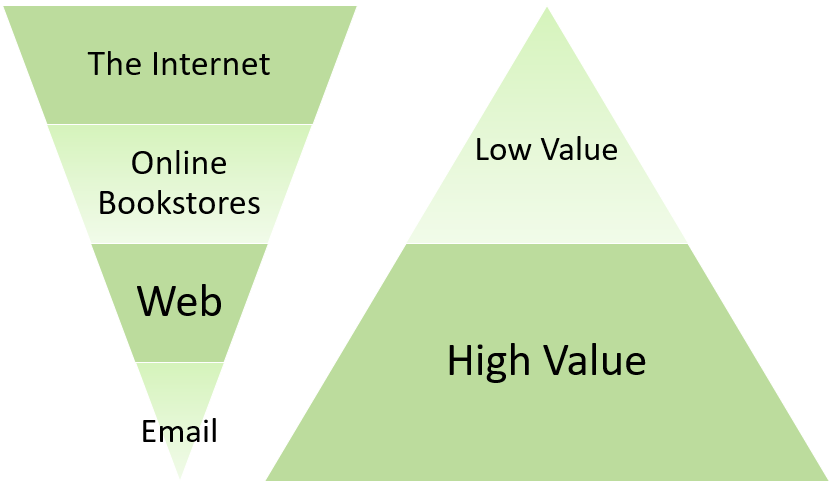
Therefore, the low-value activities are the ones you must spend the least time on, and the high-value activities are the things you need to spend the most time on.
Take a moment to let this sink in.
All the broad-based stuff like social media is low value, so you should spend the least amount of time on it. Cultivating your mailing list and maintaining your author website is high value, so you should spend the most amount of time on it.
I bet if you’ve been drinking the Internet marketing Kool-Aid, you have been doing the opposite of this.
Here’s what the data says about email vs. social media:
- 6 times as many people will see your email message first thing in the morning compared to a social media post.
- 1.5 times as many people will see your email message during the day.
- Anyone who sees your message is 250 times more likely to engage with the content in an email as with the same content in a social media post.
- 77% of people are OK with marketing messages in email. Only 4% appreciate getting marketing messages on social media.
Or to put it another way, when using social media:
You will expend over 2000 times the effort making…
… 20 times as many people hate your guts.
I’m playing with the stats here, but the fact is that on social media, you waste most of your efforts on people who don’t care. And even if they care, there is a high likelihood your message will get lost in their feed, and they will never see it.
These numbers are much worse now than they were back in 2019. Social engagement has dropped into the sub-1% range for all platforms.
Even the gurus know social media engagement is very poor. This is why they are always telling you to keep posting and posting and building and building, because they know what they’re peddling is lousy at converting browsers into readers.
Stats from 2016 show the engagement rate for email was 18%. Guess what it was for Facebook? 0.07%, that’s not 0.7%, it’s 0.07%. Fast forward to 2023, as I write the second edition, the numbers are similar—17% engagement rate for email and 0.06% for Facebook. Interestingly, Twitter’s engagement rate has dropped to 0.01%, making it no longer worth the effort.
So what are the gurus saying? You must sign up for more accounts and post more often!
Are you freaking kidding me?
Back in my business days, if a sales rep had come to me and said this, I would have told them to go get a better return or to go get another job.
You can understand why gurus give this advice. After all, how will they sell their Super-Mega-Secret-Black-White-Hat Social Media Ninja Marketing Course (yours for a bargain five hundred and ninety-seven dollars), if their advice amounted to: “to be honest mate, I think you’d be better off doing something else.”
You will do your career a great service to remember the value funnel each time you come across any marketing advice. It can make the difference between wasting huge amounts of time and making $1200 from a 10-line email.
Your Secret Marketing Weapon—WIBBOW?
Once you have got the value funnel clear in your mind, there is one more tool I find handy for getting your priorities right.
Whenever you consider any marketing activity (or any activity that isn’t writing), there is a handy acronym I believe all writers should commit to memory:
WIBBOW?
Or,
Would I Be Better Off Writing?
WIBBOW? has been credited to a few people, but its origin is not important. Getting into the habit of asking this question every time you start something that isn’t writing is important. For example:
- Surfing the net? WIBBOW? For sure.
- Browsing my Facebook feed? WIBBOW? Most definitely.
- Answering a fan mail? WIBBOW? Maybe—best to keep writing now, and answer emails in a batch this afternoon.
It’s an easy habit to get into and, trust me, it makes a tremendous difference to your productivity!
Just remember it. Make it your mantra.
Would. I. Be. Better. Off. Writing?
WIBBOW?.
I hope you now have a clear view of what your most valuable marketing activities are, and an idea of how to prioritize them. In Part 2, I will show you the exact process for putting the value funnel and WIBBOW? into practice.
Taming the Social Media Beast
In Part 2, I will show you how to use social media effectively. Given we are talking about marketing and managing time in this chapter, I thought I would finish with a few pointers on taming the social media beast, so it’s not such a huge time sink.
I am not against authors using social media, but there is no good evidence social media helps new authors—at least in the way it’s most often used.
As I said at the beginning of the chapter, in 2026, I believe the downsides far exceed the benefits, so I’ve left all platforms; however, given the lack of alternatives at this time, I can see why this won’t work for all authors.
Social media can be valuable as a great way to keep in touch with your existing fans as your success grows. If, however, you are spending any more than an hour or two a week on social media when you could be writing, you are most likely doing your career more harm than good.
To get you on the right track, here are my top 10 ways to tame the social media beast:
- Pick one social media platform as your primary channel. It doesn’t matter which one, but it’s a good idea to start with the one you are most comfortable with.
- Direct all other social media accounts to your primary channel.
- Have a separate author account from your personal account on all channels you will use as your author self.
- Post only useful content about your work. Re-posting other people’s stuff is a waste of your time.
- Use Other People’s Lists (OPL). I will explain how to use OPL in Part 2.
- It’s OK to promote your books, just not every day.
- Delete all social media apps from your phone.
- Set a time for outreach. I’ll teach you effective outreach techniques in Part 2
- Set a time for wasting time. We’re all human after all—downtime is good.
- Ask WIBBOW? every time you reach for social media.